
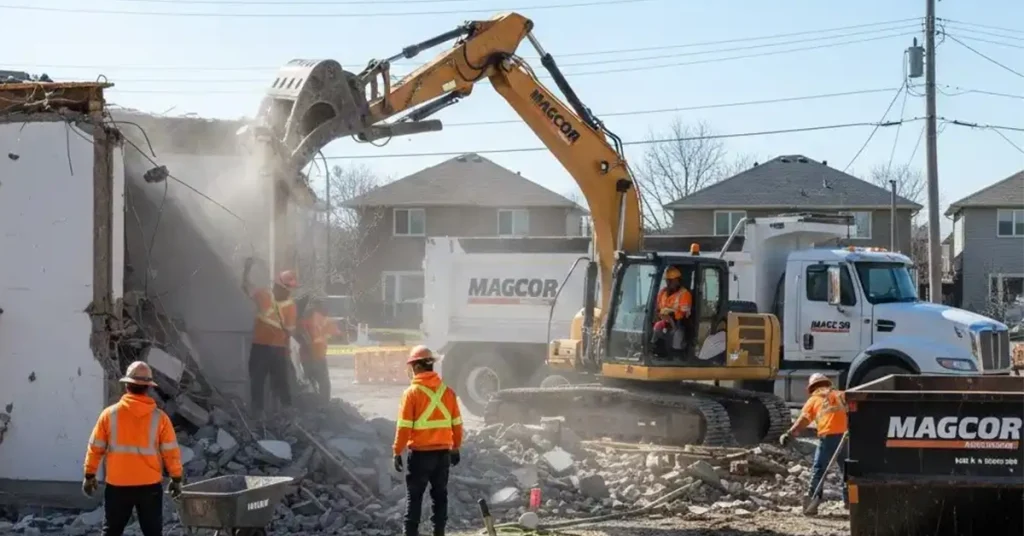
Before signing a demolition contract, ask for proof of liability insurance and a WSIB clearance certificate, confirm who pulls the permits and disconnects utilities, get the asbestos plan in writing, and nail down what the quote includes, the payment schedule and how change orders work. A legitimate Toronto contractor answers all of this without hesitation.
You have two or three quotes on the table, and they do not match. One is thousands of dollars below the others, another is vague about disposal, and none of them spells out what happens if the crew finds asbestos behind the drywall. That gap is where demolition projects go wrong, and it is also where the right questions protect you.
We wrote this from our side of the table. Hiring a demolition contractor comes down to what you ask before you sign, and since 2017 our crews have sat across from Toronto and GTA homeowners at exactly that moment. The ones who asked hard questions ended up with fewer surprises. We field these questions every week across the range of demolition work we take on across the GTA, so we know which answers should make you relax and which should make you walk.
Key Takeaways
- Vetting gets you a shortlist of demolition contractors; the contract stage is where money and liability actually lock in, so it needs its own set of questions.
- Ask for two documents before anything else: a certificate of insurance that names you and your property, and a current WSIB clearance certificate.
- Pin down who pulls the demolition permit, who arranges gas, hydro and water disconnections, and whether those costs sit inside the quote.
- Get the asbestos plan in writing, especially on a pre-1990 home, including who performs the abatement and how mid-job discoveries are priced.
- A quote that is far below every other quote is usually missing something; the fix is to ask what is not included and get the answer on paper.
- A professional contractor welcomes these questions, because they clear out the competitors who cannot answer them.
Shortlisting Is Not Signing: Why the Contract Stage Needs Its Own Questions
How to choose a demolition contractor really breaks into two stages, and most homeowners only plan for the first. Vetting is the shortlist stage: you check licensing, insurance, reviews and experience to decide who is worth a meeting. We covered that groundwork in our guide to the checks that build your shortlist, and it is the right place to start.
Signing is a different stage with higher stakes. This is the moment money and liability lock in, and a friendly phone manner stops telling you anything useful. Everything you do not write into the contract becomes your problem later, so the questions change. Instead of “are you any good,” you are asking “what exactly am I paying for, who is responsible when something goes wrong, and what does this look like the day your crew drives away.”
The questions below belong to that contract stage. Bring them to the meeting, and watch which contractor reaches for paperwork and which one reaches for reassurance.
Show Me the Paper: Insurance and WSIB
Start here, before you discuss price or schedule. Two documents matter most, and a serious contractor hands them over without a fuss.
The first is a certificate of insurance. Ask for proof of liability coverage, and ask that the certificate name you and your property for the project. This is the paper that responds if the work damages your home, a neighbour’s property or a city service. A verbal “yes, we’re insured” is not proof, so read the dates and the coverage amount.
The second is a WSIB clearance certificate. In Ontario, this document confirms that the contractor is registered with the Workplace Safety and Insurance Board and is in good standing on their premiums. It matters because if a worker is injured on your property and the contractor is not covered, you do not want that exposure landing on you. You can ask the contractor for a current certificate, and you can confirm their standing directly with the WSIB at wsib.ca, free of charge. One detail worth knowing: a clearance certificate is only valid for a set window, so on a longer job it needs refreshing rather than pulling once and forgetting.
Here is the red flag. Any hesitation, delay or excuse about producing either document ends the conversation. We are a licensed and insured demolition company in Toronto, our paperwork is current, and we would rather you check ours than take the next contractor’s word for it.
Permits and Utilities: Get the Who-Does-What in Writing
Demolition is not something you do first and document later. Any demolition contractor in Toronto works under City of Toronto rules, and the city requires permits for this work before services are shut off and walls come down. So ask three plain questions and get the answers in the contract.
Who applies for the demolition permit? Is the permit cost inside the quote, or billed on top? And who arranges the gas, hydro and water disconnections before work starts? At MAGCOR, we handle permits in-house and coordinate the disconnections as part of the job, because chasing utilities on your own while a crew waits is exactly the kind of delay that costs you money.
We keep the city specifics shallow here on purpose, because the process has its own moving parts. If you want the detail, read our breakdown of how demolition permits work in Toronto. The one line to remember: demolishing without a demolition permit in Toronto creates legal and resale problems that dwarf anything you might save by skipping it. If a contractor tells you that you do not need a permit for this, treat it as a warning, not a shortcut.
The Asbestos Question Older Homes Must Ask
If your home was built before 1990, asbestos is a real possibility, and it is the single most common source of a surprise invoice mid-demolition. You can get ahead of it with three questions.
Will there be a hazardous materials survey before demolition begins? Who performs the abatement if something is found? And how are mid-job discoveries priced, so a surprise does not become a blank cheque? Ontario rules around testing and designated substances exist for good reason, and we explain when asbestos testing is legally required in a separate guide.
This is where one accountable company matters. Our own abatement crew performs the asbestos removal rather than a subcontractor, so the plan and the price come from the same team that does the work. When testing, abatement and demolition sit under one roof, you are not caught between two firms arguing over who owns the problem. You get one plan, one timeline and one invoice.
What Exactly Is in the Quote?
This is the question that explains why your quotes differ by thousands of dollars. Two numbers can look worlds apart and still describe the same house, because one of them quietly leaves things out. So go line by line and confirm what the price actually covers.
Ask specifically about debris removal and bin or disposal fees, site cleanup, grading or backfill, hoarding and neighbour protection, and foundation removal or capped services. Confirm whether HST is stated or buried. For a full sense of how these pieces add up, our guide to what a house teardown really costs walks through the factors without pretending there is one universal price.
Then ask the one question that does more work than any other: “What is not included in this price?” Write the answer down. If you are comparing a residential demolition quote against a rival’s, the inclusions are where the real comparison lives, not the headline number. A quote that covers disposal, cleanup and protection will always read higher than one that leaves them for you to discover later.
Payment Schedule, Change Orders and the Red Flags
Money should move in step with the work, not ahead of it. A reasonable structure starts with a modest deposit, with the remaining payments tied to milestones as the job progresses. That way your payments track real, visible progress on your property.
Change orders deserve the same discipline. Ask that every change be put in writing and priced before the work happens, not totalled up as a surprise at the end. A contractor who prices changes as they go is a contractor who respects your budget.
Watch for these red flags, and treat them as a flat list of reasons to pause:
- A demand for a large cash deposit
- No written contract
- A price far below every other quote
- No fixed timeline for the work
- The phrase “we don’t need a permit for this”
One fair point about that low quote. A price well under everyone else usually means something from the inclusion checklist is missing, not that one contractor has found magic savings. Ask what is missing, and you will often find the answer yourself.
Neighbours, Protection and the Finished Site
On a tight Toronto lot, your demolition is also your neighbour’s week, and the condition of their property is part of your risk. Ask what the contractor does to manage it.
Will there be a pre-demolition condition survey of neighbouring structures, so there is a record if a dispute comes up later? What dust and vibration controls are used while the work is underway? And what does “site cleaned” actually mean in writing: graded, debris-free, fence restored? Vague language here is how a finished job turns into a lingering argument.
Ask one more question homeowners often forget: what will the site look like the day the crew leaves? Get that answer into the contract in plain terms. We treat your street like our own worksite reputation, because in this business it is, and a clean, build-ready site is the handoff we aim for every time.
The Printable Pre-Signing Checklist
Here is every question from this article as one flat list. Screenshot it, print it, and bring it to the meeting.
- Show me a certificate of insurance that names me and my property for this project.
- Show me a current WSIB clearance certificate, and confirm it will stay valid through the job.
- Confirm who applies for the demolition permit.
- Confirm whether the permit cost is inside this quote.
- Confirm who arranges the gas, hydro and water disconnections before work starts.
- Confirm whether a hazardous materials survey happens before demolition.
- Confirm who performs the asbestos abatement if something is found.
- Confirm how mid-job discoveries are priced.
- List what this quote includes: debris removal, bin and disposal fees, cleanup, grading or backfill, hoarding and neighbour protection, foundation removal or capped services, and HST.
- Tell me what is not included in this price.
- Confirm the deposit amount and the milestone-based payment schedule.
- Confirm that every change order will be written and priced before the work happens.
- Confirm there is a fixed timeline in the contract.
- Confirm there will be a pre-demolition condition survey of neighbouring structures.
- Confirm the dust and vibration controls that will be used.
- Define “site cleaned” in writing: graded, debris-free, fence restored.
A professional contractor enjoys this list, because every question on it eliminates the competitors who cannot answer.
FAQ
How much deposit should a demolition contractor ask for?
A reasonable deposit is modest relative to the size of the job, with the balance tied to milestones as the work progresses. The warning sign is the opposite pattern: a demand for a large cash sum up front, before any work begins. Ask how the deposit is calculated and what the remaining payment schedule looks like before you sign.
What insurance should a demolition contractor have in Ontario?
At minimum, liability insurance that can respond to property damage, plus WSIB coverage for the crew. Ask for a certificate of insurance that names you and your property for the project, and ask for a current WSIB clearance certificate. Read the dates and coverage amounts rather than taking a verbal assurance.
Who gets the demolition permit, the homeowner or the contractor?
A full-service demolition contractor should apply for the permit on your behalf and fold that into the project. We handle permits in-house. Be cautious if a contractor pushes the permit onto you personally, or tells you no permit is needed, since the City of Toronto requires one for this work.
What is a WSIB clearance certificate?
It is a document that confirms a contractor is registered with Ontario’s Workplace Safety and Insurance Board and is in good standing on their premiums. It protects you from exposure if a worker is injured on your property. You can ask the contractor for a current one and verify a contractor’s standing directly with the WSIB.
What should a demolition quote include?
Look for debris removal and disposal, site cleanup, grading or backfill, hoarding and neighbour protection, any foundation removal or capped services, and clearly stated HST. The most useful question is still the direct one: ask what is not included, and get the answer in writing so you can compare quotes on equal terms.
Ask Us Every One of These. We Will Enjoy It
The fastest way to find the right demolition contractor is to ask hard questions and watch who relaxes.
MAGCOR has been answering every question on this list since 2017: licensed and insured, permits handled in-house, hazardous materials managed by our own abatement crew, and a 40-plus person team that treats your street like our worksite reputation, because it is.
Call 416-663-3366 or request a free quote online, and bring the checklist. We will go through it line by line.
