
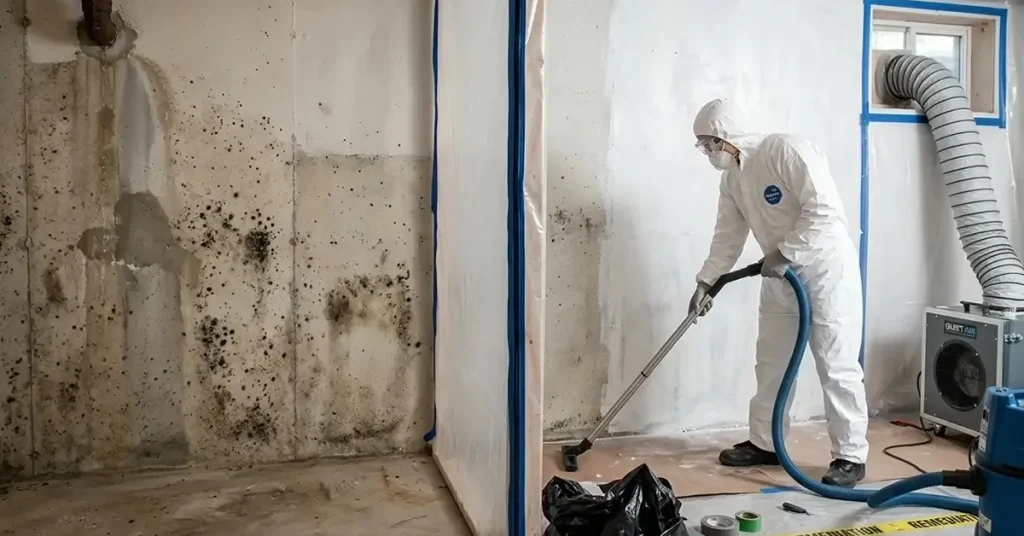
Picture this: you head up into the attic to grab some winter gear and notice dark patches spreading across the wood framing. Or maybe there is a lingering musty smell in the basement that you just cannot ignore anymore. Perhaps you had a minor plumbing leak, and now you have spotted fungal growth creeping behind the drywall. If you are like most Toronto property owners, your very first thought is probably, “How much does professional mould removal cost in Toronto?”
It is a fair question. However, mould removal does not have one standard price. Two areas that look to have the exact same visible size can involve completely different scopes of work once you factor in moisture levels, hidden contamination, accessibility, and the affected building materials. We will give you a clear market benchmark below so you know what to expect. Just keep in mind that a professional assessment is the most reliable way to determine the actual scope and price for your specific situation.
Key Takeaways
- Typical pricing varies widely: Small localized projects may cost hundreds of dollars, while extensive remediation can reach several thousand dollars or more.
- Size is only one factor: Location, accessibility, material damage, containment, moisture, and repair requirements can significantly affect the price.
- Hidden mould can increase scope: Visible mould may represent only part of the affected area.
- Containment and filtration add cost for a reason: They help control the spread of mould-containing dust and debris during remediation.
- The moisture problem must also be addressed: Removing mould without correcting the underlying dampness can allow it to return. A site-specific quote is much more useful than a generic price-per-square-foot estimate.
- Health Canada recommends: Address the underlying dampness and clean visible mould, regardless of species. This reinforces that moisture-source correction belongs in the remediation scope rather than treating only visible growth.
How Much Does Mould Removal Cost in Toronto?
If you are wondering how much mould removal costs, you need a straightforward answer. The table below outlines general Canadian market benchmarks.
| Project Scope | General Market Cost Range |
| Small localized remediation | $500 to $1,500 |
| Typical professional remediation | $1,500 to $6,000 |
| Larger or multi-area projects | $6,000 to $10,000+ |
| Extensive / whole-home remediation | $10,000 to $30,000+ |
| Broad per-square-foot benchmark | $10 to $30/sq. ft. |
Please note: These figures are broad Canadian market benchmarks and not fixed MAGCOR pricing. Final mould removal cost in Toronto depends on the actual site assessment and scope.
When looking at a mould removal estimate, remember that a proper quote accounts for the complete remediation process. We are not just wiping or treating the visible surface. Proper remediation solves the underlying problem.
What Factors Affect Mould Removal Cost?
Understanding the cost of mould removal means looking at the big picture. Here is exactly what influences your mould remediation price.
1. Size of the Mould-Affected Area
It goes without saying that larger areas usually require more labour, more containment, and more cleaning. A larger job means additional equipment operating for longer, plus more contaminated material removal and disposal. While mould removal cost per square foot is a handy metric for estimating scope, it should never be the only factor deciding the final price.
2. Where the Mould Is Located
Accessibility can significantly change the amount of labour required. Imagine the difference between treating an open bathroom wall versus a cramped crawl space. Finished basements, attics, areas behind kitchen cabinets, inside wall cavities, beneath flooring, above ceilings, or commercial mechanical spaces all present unique challenges. A small but difficult-to-access area might actually require more effort than a larger, fully exposed surface.
3. How Extensive the Mould Is Behind Finished Surfaces
What you see is often just the tip of the iceberg. Visible surface growth is one thing, but contamination extending into drywall, insulation, framing, subfloors, ceiling cavities, wall cavities, or attic sheathing changes everything. The cost of hidden mould removal is often higher because additional investigation and selective material removal are required. If you are unsure what to look for, check out our guide on 7 Signs You Might Have Hidden Mould (And Don’t Even Know It).
4. The Materials Affected
Remediation methods vary depending on whether the mould affects porous or non-porous materials. Concrete and tile can often be professionally cleaned. On the other hand, porous materials like drywall, insulation, wood framing, flooring, ceiling materials, cabinetry, and roof sheathing absorb moisture deeply. Severely affected porous materials usually need safe removal and disposal.
5. Containment Requirements
Professional remediation often requires an isolated work area to help prevent contaminated dust and debris from spreading into unaffected areas. Setting up poly containment barriers, sealed work zones, controlled access, and negative air pressure takes time and expertise. Whether protecting adjacent residential rooms or setting up commercial-space isolation, mould containment cost is a vital part of doing the job right. At MAGCOR, our mould service specifically uses containment systems and negative air pressure as part of our proven remediation approach.
6. HEPA Filtration and Specialized Equipment
Professional remediation involves much more than household cleaning equipment. We utilize HEPA air scrubbers, advanced HEPA filtration, HEPA vacuums, negative-air equipment, moisture detection equipment, and dehumidification where appropriate. Our crews also wear professional PPE. Equipment requirements depend on the project and influence the total quote. MAGCOR specifically lists HEPA air filtration and negative-air containment as part of its professional mould abatement process.
7. The Underlying Moisture Problem
Mould is a moisture problem in disguise. Common moisture causes include plumbing leaks, roof leaks, foundation water intrusion, basement moisture, condensation, poor bathroom ventilation, attic ventilation problems, high relative humidity, or previous flooding. Remediation without correcting the moisture source is a band-aid fix that can lead to recurring problems. Health Canada explicitly recommends correcting the moisture source because mould will return if the underlying dampness remains unresolved.
8. Removal of Damaged Drywall, Insulation or Other Materials
Sometimes, demolition is included in the remediation scope when affected building materials cannot be adequately cleaned or retained. This includes the removal of mould-damaged drywall, ceiling board, insulation, flooring, baseboards, cabinets, and other interior finishes. MAGCOR offers dedicated interior demolition services, including controlled removal of drywall, ceilings, and interior materials, to seamlessly support mould abatement projects.
9. Disposal of Contaminated Materials
Removed materials cannot simply be left on-site. The process involves bagging or containment, labour, transport, disposal, and rigorous site cleanup. Naturally, the quantity and type of removed material will affect the total remediation cost.
10. Repairs After Mould Remediation
It is crucial to clarify the difference between the mould cleanup cost and the restoration or reconstruction cost. After the space is safe, you might need new drywall, new insulation, flooring replacement, painting, carpentry, ceiling repairs, cabinet repairs, or structural repairs. Always check whether your quoted price includes repairs or only mould removal and cleanup.
Mould Removal Cost by Area of the Home
Location dictates strategy. Here is how different rooms impact pricing.
Attic Mould Removal
Attic mould removal costs are driven by attic size, restricted access, roof sheathing coverage, insulation removal needs, ventilation issues, condensation, working conditions, and the extent of required treatment.
Basement Mould Removal
Basement mould removal cost factors include whether the space is a finished vs unfinished basement. Foundation moisture, flood history, affected drywall and insulation, flooring, hidden wall cavities, and contents that must be protected or moved all play a role.
Bathroom Mould Removal
Do not assume every bathroom mould removal cost is low just because the room is small. Small visible growth might be straightforward, but recurring growth can indicate poor ventilation, plumbing leaks, moisture behind tile, moisture in the ceiling, or wet drywall.
Mould Inside Walls or Ceilings
Mould removal from walls or ceilings typically costs more when the growth is concealed. This requires thorough investigation, controlled opening of finishes, containment, material removal, detailed cleanup, and eventual rebuilding.
Does Mould Removal Cost More Per Square Foot for Small Jobs?
Per-square-foot pricing can actually be misleading. Small projects still require mobilization, PPE, containment, equipment setup, cleaning, disposal, and minimum labour. Therefore, a small mould patch does not translate neatly into a simple square-foot calculation. We recommend using price per square foot only as general context rather than a final quote method.
Does the Type or Colour of Mould Affect the Price?
Homeowners often specifically search for black mould removal costs. However, the colour or assumed species should not be treated as the only factor determining the remediation scope. More important pricing factors include the extent of growth, materials affected, moisture source, accessibility, containment requirements, and the amount of material to be removed. Health Canada recommends cleaning visible mould regardless of species, basing its concern more on the extent of growth and exposure circumstances than on colour alone.
Is Mould Testing Included in the Removal Cost?
Inspection, moisture assessment, sampling, laboratory testing, and post-remediation verification are separate concepts. You should always ask whether your quote includes a visual inspection, moisture assessment, mould sampling if required, laboratory fees, a written scope of work, and post-remediation verification. Testing is not always required. Health Canada recommends focusing on identifying and correcting visible mould and moisture conditions and does not make mould species identification a prerequisite for addressing visible growth.
Mould Removal vs Mould Remediation: Does It Affect Cost?
While often used interchangeably, the two terms differ. Mould removal is the physical removal of visible mould or affected material. Mould remediation is a broader process that addresses contamination and the conditions that contribute to the problem. Mould abatement can include containment, controlled removal, filtration, cleanup, and disposal. MAGCOR distinguishes these services similarly on our Toronto mould page. For a deeper dive, read our guide on Mould Removal vs Mould Remediation: What’s the Difference?.
Residential vs Commercial Mould Removal Cost
Commercial or industrial projects are often priced differently. Commercial mould removal projects in Toronto involve larger affected areas, higher ceilings, mechanical equipment, multiple containment zones, occupied-business scheduling, restricted working hours, more complex access, larger quantities of material, additional safety planning, and business interruption considerations. MAGCOR currently provides mould remediation services for residential, commercial, and industrial properties, with engineered containment used in larger industrial environments.
What Should a Professional Mould Removal Quote Include?
A detailed quote should clarify everything, leaving no room for guesswork. Look for inspection and assessment details, a defined affected area, containment plans, negative-air setup, HEPA filtration, PPE, material removal, surface cleaning, disposal, moisture-source recommendations, equipment use, labour, cleanup, verification, and any repairs or reconstruction. It should also clearly state what is specifically excluded from the quote. Compare the scope of work, rather than choosing solely on the lowest total price.
Why Can Two Mould Removal Quotes Be Very Different?
Quotes differ because contractors may not be pricing the same scope of work. One quote might include only visible surface treatment. Another might include proper containment, HEPA air filtration, removal of affected materials, disposal, moisture investigation, detailed cleanup, and repairs. Ask contractors to clearly identify what is included to ensure transparency.
Can You Reduce Mould Removal Costs by Acting Early?
Dealing with moisture problems and visible growth early may help prevent the affected area from becoming more extensive. We encourage homeowners to promptly investigate musty odours, water stains, recurring condensation, plumbing leaks, basement dampness, attic moisture, peeling paint, soft drywall, or visible mould growth. Catching 7 Signs You Might Have Hidden Mould (And Don’t Even Know It) early can keep a small issue from spreading, though it is tough to guarantee a specific dollar saving.
When Should You Call a Professional for Mould Removal?
Professional assessment becomes increasingly important when mould covers a large area, growth repeatedly returns, mould is hidden behind walls or ceilings, multiple rooms are affected, the moisture source is unknown, significant water damage occurred, contaminated materials need removal, attic or structural materials are affected, or commercial or industrial properties are involved. Health Canada recommends professional assessment and cleanup for large areas of mould, defined in its residential guidance as a single patch larger than 3 square metres. If you are facing any of these issues, it is time to look into professional mould removal in Toronto.
How MAGCOR Determines Mould Removal Pricing
Accurate pricing begins with understanding the actual conditions at your property rather than throwing out a generic number based only on visible square footage. At MAGCOR, our process starts with an initial inspection and a thorough moisture assessment. We identify visible and hidden affected areas, determine containment requirements, and plan the necessary negative-air and HEPA filtration.
From there, we identify materials to be removed and plan for safe mould removal, disposal of contaminated materials, and deep cleaning. We also provide clear moisture-control recommendations. Our final project scope is built around your specific needs. Homeowners receive a project-specific quote based on the actual remediation scope, ensuring transparency and trust from day one.
Common Misconceptions About Mould Removal Cost
“Mould removal is always priced by square foot.”
Accessibility, containment, and material removal can be just as important as the physical area.
“A small visible patch means a small project.”
Hidden moisture or concealed mould behind walls may significantly change the scope of work.
“Black mould automatically costs more.”
Remediation requirements should be based on actual property conditions and moisture sources rather than colour alone.
“The cheapest quote includes everything.”
You should always compare the written scope. Lower quotes often skip crucial steps like containment or moisture control.
“Removing visible mould solves the moisture problem.”
The underlying water leak, condensation, or humidity issue must also be addressed, or the mould will return.
“Repairs are always included in remediation pricing.”
Reconstruction, painting, or finishing are often quoted separately from the abatement process.
Why Choose MAGCOR for Mould Removal in Toronto?
When dealing with a sensitive issue like mould, you need a partner you can trust. MAGCOR is a fully insured contractor offering extensive service coverage across Toronto and the GTA. We handle residential mould remediation, commercial mould removal, and industrial mould abatement with trained and certified crews.
Our approach includes detailed moisture assessment, professional containment, negative air pressure, and HEPA filtration. We manage safe removal of contaminated material and strict disposal procedures, utilizing our interior demolition capabilities where required. With customized project scopes and free quotes and assessments, we solve the root cause of your problem so you can breathe easier.
Get an Accurate Mould Removal Quote for Your Toronto Property
Mould remediation cost in Toronto depends on far more than the size of the visible patch on your wall. The biggest pricing variables include the size of the affected area, location, accessibility, hidden growth, materials affected, containment, equipment needs, moisture correction, demolition, disposal, and follow-up repairs.
While general online cost ranges are useful for initial budgeting, a site-specific assessment is necessary for accurate pricing. Protect your property and your peace of mind by getting the job done right the first time. Contact MAGCOR today for an expert inspection and a detailed mould removal quote tailored to your space.

Pingback: 7 Signs You Might Have Hidden Mold (Without Realizing It)